
Read This Before You Share Another Political Post
What sixteen years inside an autocracy taught me about information warfare

I spent sixteen years living in Hungary under the Orban regime. In that time I learned a great deal about how lies work at an industrial scale. One of the most important things I took away: if we cannot name what we are seeing, we cannot defend against it.

The three core concepts
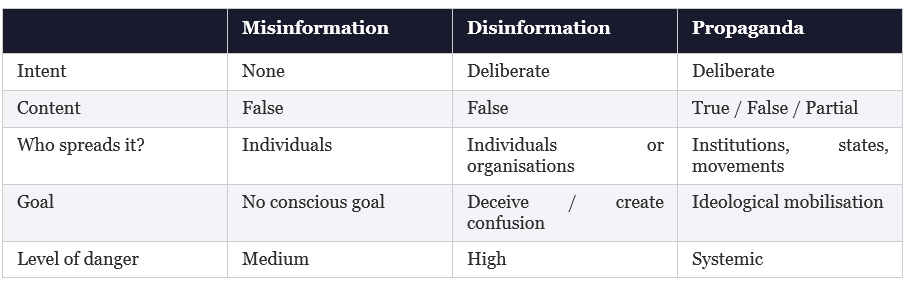
Misinformation: false information, no intent
Someone shares a health tip they genuinely believe is true. It is not. They were misled, but they pass it on with good intentions. That is misinformation. It spreads through trust: family group chats, well-meaning friends, people who just wanted to help. During COVID, false cures spread from people who sincerely wanted to help. No bad actor required, yet real harm was done.
The danger of misinformation is not malice. It is scale. A billion misdirected good intentions can cause the same damage as one deliberate lie.
Disinformation: deliberate deception
This is far trickier, because here someone knows they are lying and does it anyway. This is never a mistake. It is a weapon. Fabricated documents, deepfake videos, coordinated social media campaigns, fake news sites built to look legitimate. In Hungary, the disinformation around migrants, Soros and the EU was not born from misunderstanding. It was strategically produced, publicly funded and systematically distributed.
Disinformation does not necessarily need you to believe the lie. It just needs you to doubt the truth.
Propaganda: systematic manipulation
Propaganda is not necessarily a lie, but it is always manipulation. It can use true facts, selectively. It only shows what reinforces its own narrative. It is always institutional: it comes from governments, parties, movements. It works through repetition. The Goebbels principle: say it enough times and it starts to feel true.
At a glance
The tactics: how it works in practice
The three concepts are the theory. In practice they operate through specific tactics, and every one of them has a name. Once you know the names, you will see them everywhere.
Gaslighting: leads you to question your own perception of reality. It does not only happen in abusive relationships, it can be deployed against entire societies. The goal is not to make you believe a specific lie. The goal is to make you distrust your own judgement. You might think this could never happen to you — that you would always trust your own eyes over the noise coming at you. But believe me: if you are bombarded long enough with the message that you are wrong, that things are not how you see them, sooner or later you start asking yourself: what if they are right?"
Flooding the zone: Steve Bannon put it plainly: flood the zone with sh*t. So much noise, so many contradictory stories, that eventually you give up. You conclude it is all too complicated, that you cannot possibly understand it, so you might as well let it go. When everything looks like spin, people switch off. And switching off is exactly what the system needs.
Manufactured doubt: invented by the tobacco industry. You do not need to prove cigarettes are safe. You just need to create enough doubt about whether they are dangerous. The same playbook repeats with climate change, vaccines, election results. They do not attack the truth. They attack the certainty of the truth. Doubt is cheaper than evidence. And far more durable.
Whataboutism: A supposedly Soviet invention, perfected in the digital age. When confronted with an uncomfortable truth, do not deny it, deflect it. The government is corrupt? And what about Soros? It looks like an argument, but it is not. Its only purpose is to redirect the conversation until accountability itself starts to feel hypocritical, and people stop demanding it.
False equivalence: two fundamentally different things are presented as equal. A classic example: all politicians are the same. They are not, but the claim flattens the conversation and the possibility of a meaningful debate disappears with it.
Narrative capture: you do not have to believe every individual claim. You just have to accept the worldview behind them. Global shadowy powers. Our nation is under attack. There are traitors among us. Once everything is pushed inside a false narrative, the storytelling is already under control.
Cynicism as a weapon: its goal is not to persuade but to feed hopelessness. Everyone is corrupt. All politicians are the same. In Hungary I noticed that if anyone raised morality as a relevant consideration, people immediately turned on them: who are you to moralise? That reaction did not come from nowhere.
Learned helplessness: this is the final destination, the combined result of all the others. When people stop resisting, not because they do not care, but because they have learned that their actions make no difference. This is the most effective tool of authoritarian control, because it requires no force. People silence themselves: they opt out, stay home, scroll instead of act.
Learned helplessness is not apathy. It is a wound. And like every wound, it can heal.
How they work together
In practice these rarely operate in isolation. They form a complete information laundering pipeline:
• A troll farm produces a false story (disinformation)
• A partisan outlet picks it up and frames it as news (propaganda)
• A well-meaning reader shares it in the family group chat (misinformation)
The grandmother is not guilty. But the damage is done regardless.
The system does not need to deceive everyone. It is enough to confuse enough people, exhaust enough people, or silence enough people.
Five things you can do, starting today
This is not the advice to distrust everything. Someone who believes nothing is paranoid, and someone who believes everything is fool. The goal is to find the balance between the two, and simply stay informed.
• Ask who benefits. With any piece of information that seems designed to provoke, this question has an answer.
• Check the source, not just the content. A true fact can be weaponised when stripped of context.
• Remove the pages and accounts you know are propaganda from your feed - don't try to filter them yourself, just don't let them in.
• Lateral reading: when evaluating a source, do not read deeper into it. Open a new tab and look up what others say about that source. This is what professional fact-checkers do.
• Slow down at strong emotions. If something makes you want to share it immediately because it is outrageous or perfectly confirms what you already think, wait. That urgency is often manufactured.
• Name what you see. If you recognise a tactic, say it out loud: that is whataboutism, that is flooding the zone. Naming it breaks the spell. It moves you from feeling to thinking.
The existence of these tactics does not mean the truth is impossible to find; it means the truth requires effort, and people willing to make that effort. Democratic societies have survived sophisticated propaganda before. What is different today is the speed and the scale. What is the same is the remedy: informed citizens who refuse to stop paying attention.
You do not need to know everything. You just need to know enough to ask the right questions, and to keep asking them.
Share this with someone who needs it. Because an informed person in your life is one fewer person the information machine can use.
This is part of an ongoing series on democracy, civic awareness and political self-defence.
Keep reading. Keep asking.
If this was useful, chip in!
Until next time. Keep your eyes open.
Excellent article. This is happening in the UK re. a range of issues, and probably leading to the rise of Reform. Really helpful to read this, and I’ll be sharing.
A great summary. Lots to take away from, love that you brought up whataboutism, that one is a huge pet-peeve of mine!! Also, I was unaware of the difference of misinformation and disinformation, so thank you for sharing and letting me learn something :)